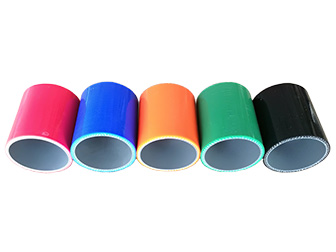
Choosing between a standard silicone hose and a fluorosilicone-lined silicone hose depends largely on the media inside the hose. Standard silicone offers good heat resistance, flexibility, and weather resistance. However, prolonged contact with certain fuels, oils, or chemicals may cause swelling, softening, or changes in physical properties.
For applications involving both temperature requirements and exposure to petroleum-based fluids, fluorosilicone may be a more suitable material. Buyers should understand the differences between VMQ and FVMQ, as well as the distinction between a hose made primarily from fluorosilicone and an FVMQ-lined silicone hose.
This guide compares their material properties, construction, applications, and key selection factors to help buyers identify a suitable hose design.
Key Takeaways
-
Standard silicone (VMQ) provides good heat resistance, flexibility, and weather resistance but has limited resistance to many petroleum-based fuels and oils.
-
Fluorosilicone (FVMQ) offers improved resistance to many fuels, oils, and selected chemicals, but has certain chemical and mechanical limitations.
-
An FVMQ-lined silicone hose combines a fluorosilicone inner layer with a conventional silicone hose body.
-
Material compatibility, operating temperature, pressure, and hose construction should all be evaluated before selection.
What Is Fluorosilicone (FVMQ)?
Fluorosilicone, commonly abbreviated as FVMQ, is a modified silicone rubber containing fluorinated groups in its polymer structure. Like conventional silicone rubber (VMQ), it offers flexibility and good low-temperature performance. Its fluorinated structure also provides improved resistance to many fuels, oils, and hydrocarbon-based fluids.
Note:
SUNRISE uses "FMVQ" on its product page to refer to FVMQ (fluorosilicone).
One of the main differences between VMQ and FVMQ is chemical compatibility. Standard silicone performs well in many hot-air, coolant, and general-purpose applications, but it has limited resistance to many petroleum-based fluids. FVMQ is often selected when a silicone-based material needs better resistance to these media.
FVMQ should not be confused with FKM (fluoroelastomer). Although both are fluorinated elastomers, they have different polymer structures and performance characteristics. FVMQ retains silicone-based properties such as flexibility and low-temperature performance, while FKM is a different fluoroelastomer commonly selected for applications requiring resistance to various fuels, oils, and chemicals. Neither material is universally suitable for all media, so compatibility should be verified against actual operating conditions.
Fluorosilicone vs Silicone Hose: What Are the Key Differences?
The following table highlights the general differences between standard silicone rubber and fluorosilicone.
Property
|
Standard Silicone (VMQ)
|
Fluorosilicone (FVMQ)
|
Fuel resistance
|
Limited resistance to many petroleum-based fuels
|
Better resistance to many petroleum-based fuels
|
Oil resistance
|
Limited resistance to many petroleum-based oils
|
Better resistance to many petroleum-based oils
|
Heat resistance
|
Generally good, depending on formulation
|
Good, but may have lower hot-air resistance in some formulations
|
Low-temperature flexibility
|
Generally excellent
|
Generally very good
|
Weather and ozone resistance
|
Excellent
|
Excellent
|
Chemical compatibility
|
Suitable for selected media
|
Better compatibility with selected fuels and oils, but limited with certain chemicals
|
Mechanical properties
|
Generally good, depending on compound
|
Can have lower mechanical strength and abrasion resistance
|
Material cost
|
Generally lower
|
Generally higher
|
Fuel and Oil Resistance
Fuel and oil compatibility is one of the main reasons to consider FVMQ instead of standard silicone.
When exposed to incompatible fluids, standard silicone may swell or lose physical stability. FVMQ generally provides better resistance to many petroleum-based fuels and oils, making it a more suitable option for selected fuel- and oil-contact applications.
However, FVMQ is not resistant to every fluid. Its compatibility with alcohol-containing fuels, ketones, aldehydes, amines, brake fluids, and other polar chemicals should be checked separately. The exact fuel formulation, additives, operating temperature, and exposure duration can also affect material performance.
Buyers should therefore verify compatibility against the actual media rather than assume that FVMQ is suitable for every fuel or oil application.
Temperature and Mechanical Performance
Both VMQ and FVMQ can provide good temperature performance and low-temperature flexibility. However, their performance differs depending on the formulation and exposure conditions.
Although FVMQ combines silicone-based flexibility with improved fuel and oil resistance, it may have lower hot-air resistance than conventional silicone in some formulations. Temperature limits in contact with fuel or oil may also differ from dry-heat limits.
FVMQ can also have lower mechanical strength and abrasion resistance than standard silicone in certain compounds. Tensile strength, tear resistance, compression behavior, and pressure capability depend on the compound and finished hose design.
Material selection should therefore consider the complete operating environment rather than temperature or chemical resistance alone.
Fluorosilicone Hose vs. FVMQ Lined Silicone Hose: Understanding the Construction
The terms fluorosilicone hose and FVMQ-lined silicone hose can describe different hose constructions.
A fluorosilicone hose may refer to a hose made primarily or entirely from FVMQ material, depending on the manufacturer's product definition. In this construction, fluorosilicone forms the main hose body.
An FVMQ-lined silicone hose uses a layered construction:
-
Inner layer: FVMQ fluorosilicone, which contacts the conveyed media.
-
Main hose body: Conventional silicone, which provides the main body structure.
This design combines the improved fuel and oil resistance of FVMQ at the fluid-contact surface with the flexibility and structural characteristics of a silicone hose body.
The distinction matters when comparing product specifications. Buyers should confirm whether the quoted hose is made primarily from FVMQ or uses an FVMQ inner lining with a silicone outer structure.
How Does an FVMQ Lining Improve Fuel and Oil Compatibility?
In an FVMQ-lined silicone hose, the inner lining provides the fluid-contact surface between the conveyed media and the silicone body.
When a standard silicone hose is exposed to an incompatible fuel or oil, the fluid may penetrate the rubber and cause swelling, softening, or changes in dimensions and mechanical properties. These changes can affect sealing performance and shorten hose service life.
An FVMQ inner lining provides a more compatible contact surface for many petroleum-based fuels and oils. By reducing direct exposure of the conventional silicone body to incompatible media, the lining helps lower the risk of fluid-related deterioration.
The effectiveness of this construction depends on the FVMQ compound, lining thickness, bonding quality, and actual exposure conditions. It should be evaluated through media compatibility testing rather than assumed from the material name alone.
What Industries and Applications Use FVMQ Lined Silicone Hoses?
FVMQ-lined silicone hoses are considered for applications where silicone's temperature and flexibility characteristics need to be combined with improved resistance to selected fluids.
Automotive Air Intake and Turbocharger Systems
Certain automotive air intake and turbocharger-related systems may expose hose surfaces to oil mist, fuel, or other fluids. An FVMQ lining can help address these compatibility requirements when the hose is designed and validated for the specific application.
Automotive Coolant and Related Systems
Some automotive coolant systems use formulations containing organic acid technology (OAT) inhibitors or other additives. Certain aggressive rust inhibitors and by-products from exhaust gas recirculation (EGR) systems may also create material compatibility challenges.
An FVMQ-lined construction may be considered for these environments, but compatibility depends on the specific fluid formulation and operating conditions. Testing should confirm whether the lining is suitable for the conveyed media.
Industrial Equipment
Industrial machinery may use hoses that come into contact with lubricating oils, oil mist, or selected chemicals. An FVMQ-lined construction may be considered when standard silicone does not provide sufficient media compatibility.
For all these applications, the final hose specification should be based on actual operating conditions and compatibility data.
How to Choose Between Silicone and FVMQ Lined Silicone Hose
Before selecting a hose, buyers should review several factors:
-
Identify the conveyed media. Confirm the exact fuel, oil, coolant, or chemical, including its additives and concentration. Do not rely on general material descriptions alone.
-
Check operating conditions. Consider continuous and peak temperatures, pressure, vacuum, and exposure duration.
-
Evaluate the hose construction. Determine whether a standard silicone hose, an FVMQ-lined silicone hose, or a hose made primarily from FVMQ is appropriate.
-
Review mechanical requirements. Check dimensions, bend radius, reinforcement, connection design, and installation space.
-
Request compatibility data. Where fluid exposure is critical, ask for relevant material or finished-hose test data under representative conditions.
As a general selection guideline:
-
Choose standard silicone hose when the application requires heat resistance, flexibility, and weather resistance without significant exposure to incompatible fuels or oils.
-
Consider an FVMQ-lined silicone hose when the main hose body can be silicone but the fluid-contact surface requires improved resistance to selected fuels, oils, or chemicals.
-
Consider a hose made primarily from FVMQ when the application requires fluorosilicone throughout the hose body.
The final selection should always be based on media compatibility, operating conditions, and finished-hose specifications.
FVMQ Lined Silicone Hose Options
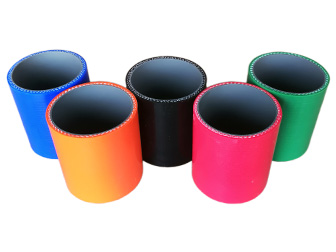
For applications requiring an FVMQ inner lining and a silicone hose body, different configurations can be considered according to the installation requirements.
Available designs include straight hoses, 45-degree hoses, 90-degree hoses, hump hoses, and coupling hoses. Color options include black, red, blue, orange, yellow, purple, and green.
Custom dimensions, shapes, and colors can be discussed according to application requirements. Buyers can provide drawings, samples, or project specifications for evaluation.
Have a drawing or sample? Contact SUNRISE to discuss custom FVMQ-lined silicone hose solutions.
FAQ
Are fluorosilicone FVMQ lined silicone hoses suitable for automotive applications?
They can be suitable for selected automotive applications involving exposure to fuel, oil mist, certain coolant additives, or other chemicals. The final selection depends on the fluid type, temperature, pressure, and hose construction. Compatibility should be verified for the specific application.
What are the typical temperature limits for fluorosilicone lined silicone tubing?
Published FVMQ material data show that some compounds have service temperature ranges around -60°C to +177°C (-76°F to +350°F). Other material specifications define different ranges depending on the compound classification and test conditions.
These figures refer to fluorosilicone materials, not the rated limits of every FVMQ-lined silicone hose. The finished hose's operating range also depends on the silicone body, lining thickness, bonding, fluid exposure, and pressure conditions. Buyers should request the manufacturer's rated specifications for the complete hose.
Is FVMQ more resistant to fuel than standard silicone?
Generally, yes. FVMQ offers better resistance to many petroleum-based fuels than standard VMQ silicone. However, resistance varies with fuel formulation, additives, temperature, and exposure time. Some alcohol-containing fuels and other chemical mixtures require separate compatibility checks.
Can an FVMQ lined silicone hose replace a standard silicone hose?
It may replace a standard silicone hose when improved fuel or oil resistance is required and the FVMQ-lined construction meets the application's mechanical and temperature requirements. It should not be treated as a direct replacement without checking dimensions, pressure ratings, media compatibility, and installation conditions.